
Navigating Danish Genealogy – Census Records
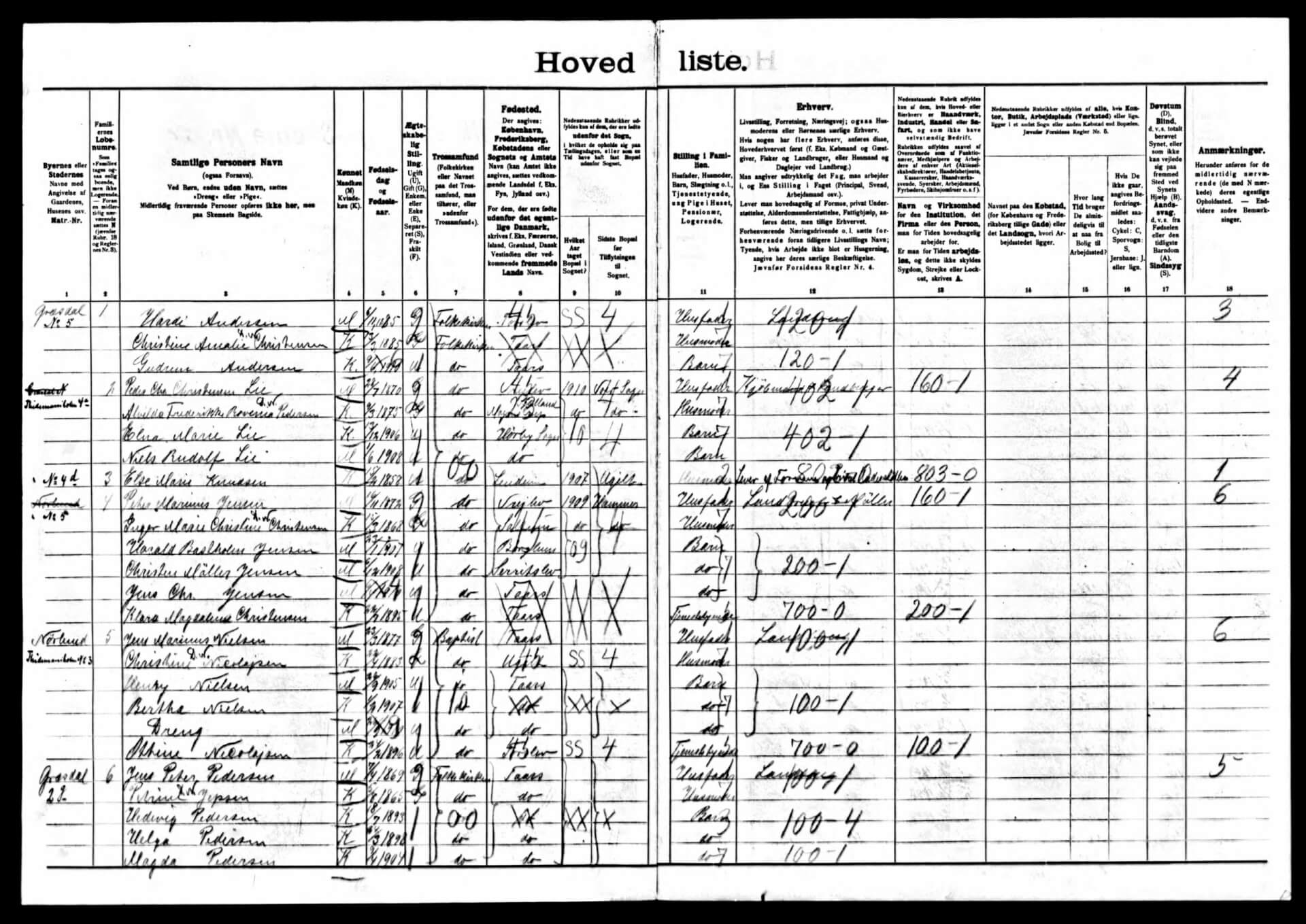
What can we learn from census records? Census records are one of several primary sources used in genealogy research.
In the United States, the Constitution mandates that a national census occurs every 10 years. The first federal census occurred in 1790, and the most recent in 2020. Data from the 1890 census is mostly non-existent since these documents were destroyed in a fire. Data on individuals is not available for 72 years by law for privacy reasons. As of 2025, the most recent publicly available census is 1950.
In addition to the federal census, most states conducted censuses at various points in time, particularly during peak periods of pioneer settlement and immigration. These state census records generally contain less data but can be useful for tracking individuals in the gaps between federal censuses, particularly in the 1880s and 1890s given the lack of a federal 1890 census.
In Denmark, censuses have been held at irregular intervals (usually 5-10 years), with the earliest available census data from 1769. Data is publicly available for all censuses up to 1940. Since 1971, Denmark has used its Civil Registration System (CPR) to track births, deaths, marriages, and other personal information, and data from this database is used to generate population and demographic information, rather than a census.
Analysis of census data can give us insight into individuals, families, and historical and cultural norms. The most obvious piece of information is revealing where a person lived at a particular point in time. In most cases, a census may be the only piece of information to confirm a person’s existence in time and place. Just as important, though, it reveals personal relationships.
Census data tells us everyone living in one household and the relationships between them. Households may often be a married couple with children of various ages. There may be paid servants in the household (which did not mean someone was wealthy). There could be multiple generations in the household, including elderly parents–it was common for a widowed parent to live in the household of one of their children.
Most of my research experience with Danish census information has come from rural areas of Denmark in the 19th century, so these observations are reflective of that subset. Children often left home as teenagers to seek work, unless they were able to be employed in the family’s farm operations. Normally, they would move to a nearby farmstead to live and work as a servant or farmhand.
In the case of a spouse’s death at a young age, it was common for the widowed spouse to remarry within a few months, likely for economic reasons. Married couples would often have a significant number of children born over an extended period. Women would continue to give birth in their late 30s and early 40s as long as nature allowed. Child mortality rates were relatively high–15% of children did not survive their first year of life in 1835.
In general, reviewing census records from 19th century Denmark points to two of the major factors that led to emigration from Denmark–poverty and overpopulation. The population grew rapidly in 19th century Denmark, and economic conditions made it difficult for young people to find livelihoods, particularly in rural areas. This led many to risk everything to seek new opportunities in North America.
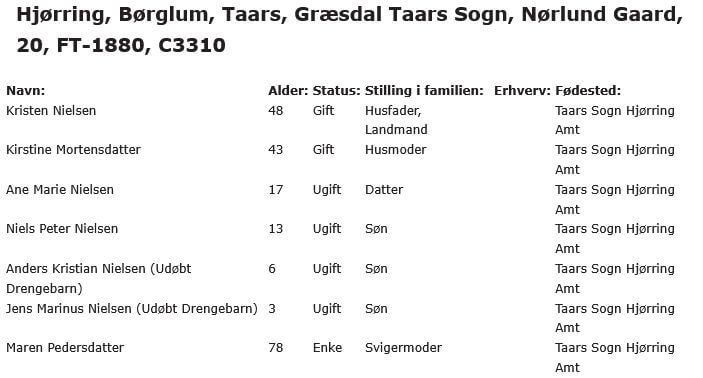
Household listing from the 1880 Denmark census in Taars parish, Hjørring county, obtained from Dansk Demografisk Database. Anders Kristian Nielsen is the author’s great grandfather.
– Eric Mortensen, Genealogy Center Manager & Project Archivist