
Navigating Danish Genealogy – Fixed Family Surnames

In my previous blog post, I wrote about patronymic names in Danish history. Examples of patronymic names are Hansen or Hansdatter, where the surname was not a family name but simply meant the person is the son or daughter of Hans. Patronymic names were not passed from one generation to the next since they were based on the name of the person’s father.
In 1828, King Frederik VI issued a decree that everyone should have fixed family names. Parents could either give the child the same surname as the father (freezing the patronym and passing it to future generations) or adopt a place name as a surname. The decree also stated that all siblings should have the same surname, meaning that girls would no longer be given “datter” names. (All the children of Hans would be named Hansen regardless of gender.)
Although this was the beginning of the end of patronymic names, they continued to be used, particularly in rural areas. There was resistance among many to government intervention in personal traditions. In 1856, a law was passed making it mandatory to use fixed family surnames, reinforcing the earlier royal decree.
In the 19th century, there were only a handful of male given names being used. As a result, when patronymic names were frozen and passed onto future generations, most of Denmark shared the same few family names. Nielsen, Jensen, Hansen, Petersen, Andersen, Christensen, Larsen, Sørensen, Rasmussen, and Jørgensen were the top ten family names in Denmark in 1801, and those same ten names were the top family names in 2024.
In 1904, because so many people had the same surnames, a new law was passed that allowed changing a surname to a name used by a parent or grandparent, or the name of a property which had been owned by the family. This brought about further changes in Danish family names.
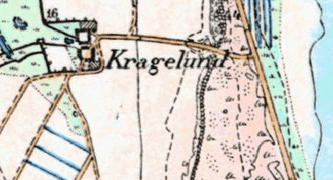
As a result of changes to naming laws in the mid-19th century, we see more Danish surnames derived from places. Two of my ancestors are Peder Sørensen Kragelund, born in 1805, and his son Søren Pedersen Kragelund, born in 1854 in Denmark. Here is an example of the patronymic name used in combination with a place name. Kragelund is presumably derived from the name of a farmstead which appears in 19th century maps in Als Parish, Aalborg County, where Peder was born.
Søren Pedersen Kragelund immigrated to Iowa in the mid-1870s and lived in nearby Oakfield township. The name on his tombstone is Soren P. Kragelund – Kragelund was the name he used in the United States and the family name passed on to his descendants. The name Kragelund – a small farmstead in 18th- and 19th-century Denmark – now lives on as the surname of present-day Americans and Danes.
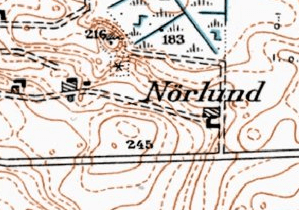
Recently, I discovered the use of a placename used as a middle name. My grandfather’s name was Axel Nørlund Nielsen. When researching his ancestors, I discovered that many generations had lived and worked on a farmstead called Nørlund in Tårs Parish, Hjørring County. The name Nørlund was then transplanted to the United States when my grandfather emigrated in 1909. Axel’s first son was given the name Norlin, presumably from the same derivation, but with alternate spelling. I wonder now if my grandfather Axel or my uncle Norlin were aware of the source of the name.
The use of place names can therefore point us to specific places where our ancestors lived and worked. What hidden nuggets are waiting to be discovered in your genealogy?
– Eric Mortensen, Genealogy Center Manager & Project Archivist