
Navigating Danish Genealogy – The Schleswig Question
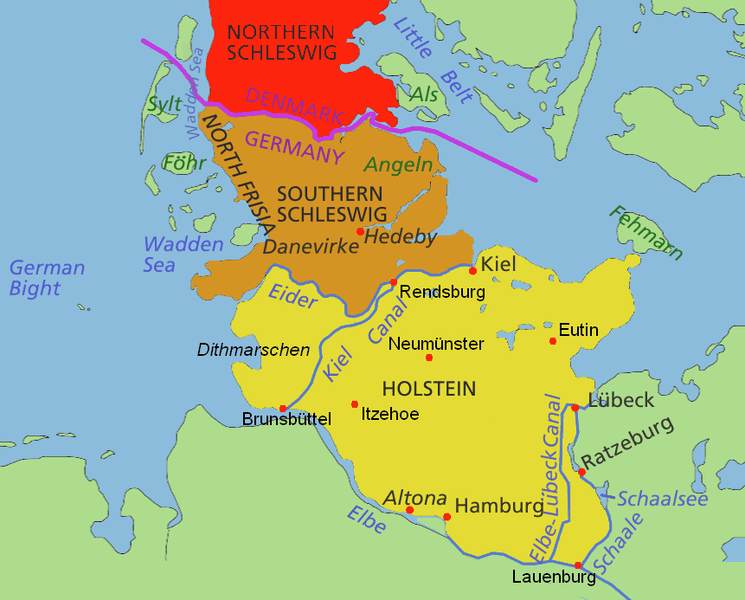
One question I often get asked is “Were my ancestors Danish or German?” This arises from the fact that the area known historically as Schleswig has been claimed at times by both Danish and German political entities. While people today like to categorize and identify our ancestors based on their nationality and/or ethnicity, these do not always have straightforward answers.
Here’s a quick history of the region and how the borders have changed over the years.

The area of the southern Jutland peninsula, Sønderjylland, also known as Schleswig (German) or Slesvig (Danish), has always been strategically important as a transit and trading space between the Jutland peninsula and the German-speaking areas of Europe, as well as between the North Sea and Baltic Sea. The Dannevirke, a series of earthwork barriers and fortifications across the peninsula, shows this importance.
In 811, a treaty between the Danish king and Charlemagne established the southern border of Denmark (including Schleswig) at the Eider River. Schleswig later became a duchy, separate from Denmark proper, but the title of Duke of Schleswig was historically held by the King of Denmark.
Starting around 1800, more of Schleswig began to speak German rather than Danish. This coincided with rising feelings of nationalism – the idea of a nation state with fixed borders and people of common language and ethnicity – which pervaded Europe in the 19th century. This led to the “Schleswig question” and two wars.
Schleswig and Danish-German border changes over time. Image courtesy economist.com.
The First Schleswig War, called the Treårskrigen in Danish, lasted from 1848 to 1851. The duchies of Schleswig, Holstein, and Lauenburg were under the control of the King of Denmark, but not part of Denmark proper. Danish politicians sought to integrate Schleswig as part of Denmark, which provoked a rebellion among the German population of Schleswig. Denmark won the war and retained control over Schleswig.
The Second Schleswig War took place in 1864, when Denmark again tried to integrate Schleswig as part of Denmark proper. While the first war was largely Germans from Schleswig and Holstein fighting against Denmark, the second war was the larger armies of Austria and Prussia fighting against Denmark. The Danes lost the war and control over Schleswig, Holstein, and Lauenburg, which became a part of the Prussian, later German Empire.
In 1920, a plebiscite was held in Schleswig. The northern half voted to be part of Denmark, and the southern half voted to be part of Germany. The vote was respected by both countries, the former duchy of Schleswig was divided, and the current border between Denmark and Germany was set. Today, a minority of Danish-speaking people live in German Schleswig, and a minority of German-speaking people live in southern Denmark.
Identifying nationality can be a shifting target, as seen with the area of Schleswig. More important is how individuals personally identified, which is most often indicated by their primary language and cultural background.
– Eric Mortensen, Genealogy Center Manager & Project Archivist